Yellowstone Wildlife | the big 5 not to be missed
On 1st March 1872 President Grant signed the bill that created Yellowstone, the first national park in the USA. Within Yellowstone's 2.2 million acres, visitors have unparalleled opportunities to observe wildlife in an intact ecosystem while exploring geothermal areas that contain about half the world’s active geysers. Just in case you didn't already know, when visiting Yellowstone you are standing on top of one of the world's 20 known supervolcanoes!
Practicalities
To get the most from your trips to the national parks visit my blog The best USA National Parks for hiking, wildlife, and scenery. We combined our visit to Yellowstone with a trip to Grand Teton National Park, if you have more time you can also take in Glacier National Park.
Many companies provide day trips to Yellowstone from the town of Jackson, which is just south of Grand Teton National Park, but Yellowstone is massive and spending just one day in the park is selling yourself truly short. To get a feel for what Yellowstone is about you really need to immerse yourself in the park, which is what we did by camping there for the best part of a week. There are multiple well equipped campgrounds, which need to be booked well in advance. The number of hotels and cabins in Yellowstone is limited, and these don't come cheap.
Yellowstone has plenty of bears, as such camping comes with strict rules in terms of what you can cook and food storage - don't plan to cook anything full of flavour as a bear's sense of smell is 100 times better than your dog's. More about Yellowstone's ''Big 5'' later.
Although daytime summers temperatures in Yellowstone tend to be warm, and sometimes hot, we got a bit of a shock on our first night camping when having fallen asleep cosy warm, we awoke absolutely freezing a few hours later - we should not have been surprised given that the park is essentially a broad, elevated, volcanic plateau, between 7,000 and 8,500 feet.
One of the hidden pleasures of Yellowstone is mobile phone coverage is almost nonexistent and few very places in the park have Wi-Fi .... chatting over the day's adventures was so much more enjoyable than watching people scroll through social media. Many people waste far too much time living their lives through other people's eyes .... enjoy as many moments of your own life as you can, you can't get them back.

Supervolcanoes
Concealed beneath the park rests the Yellowstone Caldera, the largest supervolcano in North America. Each year, millions of visitors trek over a massive magma chamber that stretches from 5-17 km beneath the surface and is about 90 km long and 40 km wide. A little deeper rests another chamber that's more than 4 times larger.
An eruption of the Yellowstone Supervolcano would release the total energy equivalent to an 875,000 megaton explosion, and lava would bury anything within a forty-mile radius of the eruption. Yellowstone's plume of ash, lava, and volcanic gases would reach a height of fifteen miles and be blown across North America. Ash would darken the skies and blanket the ground from coast to coast. A likely worldwide volcanic winter could see global average temperatures plunge as much as 18 degrees Fahrenheit for a decade. On a cheerier note, such an event is pretty unlikely to happen during your visit - the Yellowstone Supervolcano has unleashed only three cataclysmic eruptions in the past 2.1 million years; the most recent one being 640,000 years ago.

Half of the world’s hydrothermal features are found at Yellowstone
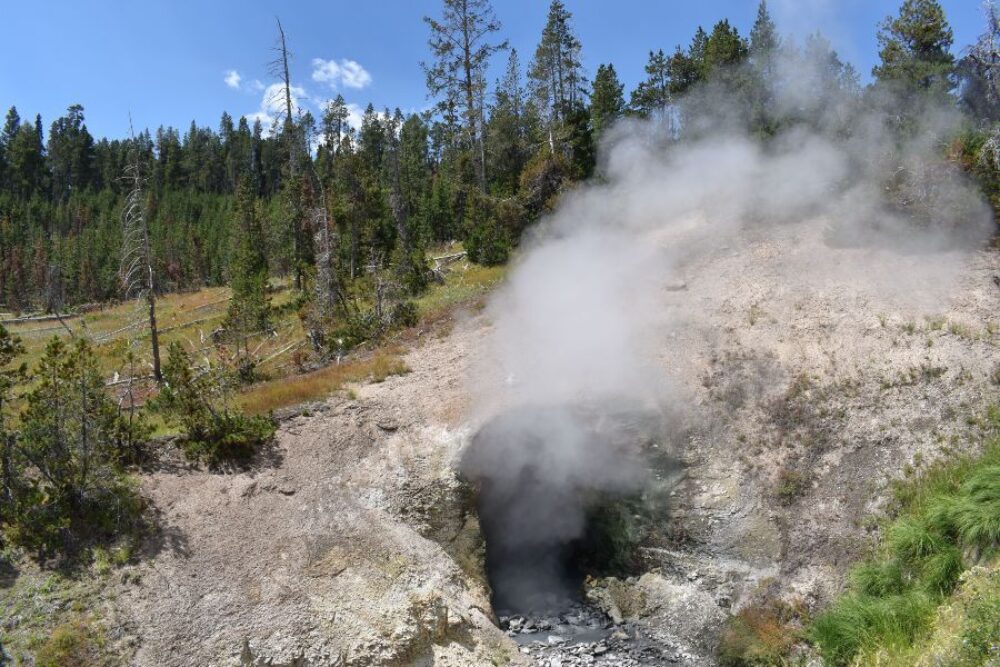
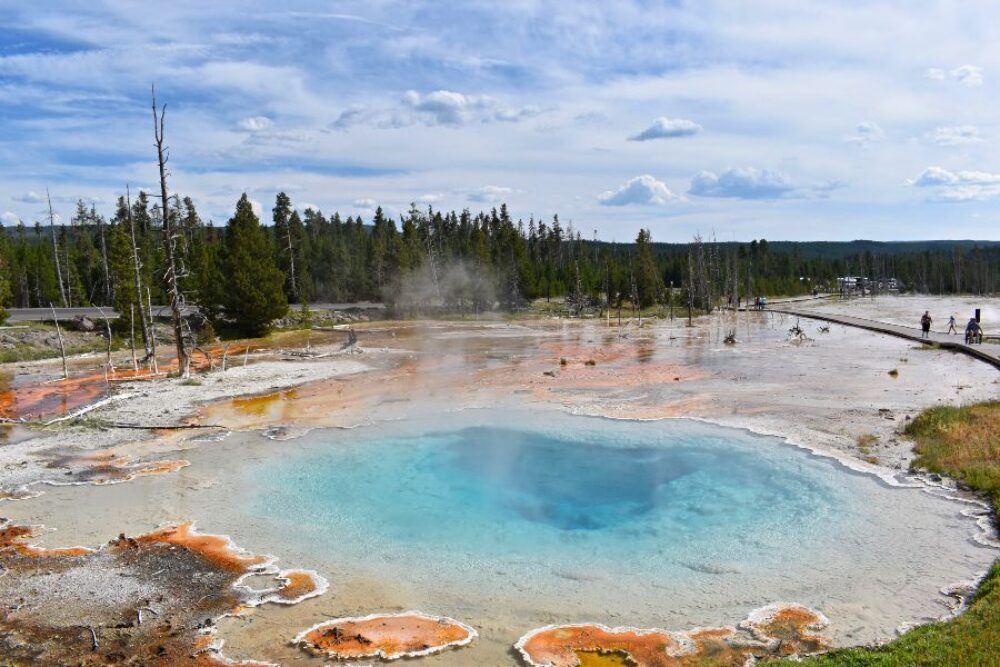
Yellowstone preserves more than 10,000 hydrothermal features - an extraordinary collection of hot springs, mudpots, fumaroles, travertine terraces, and of course, geysers. Microorganisms called thermophiles (meaning “heat loving”) live in these features and give the park its brilliant colours.
The most popular hydrothermal areas, as marked out on the map above, are as follows:
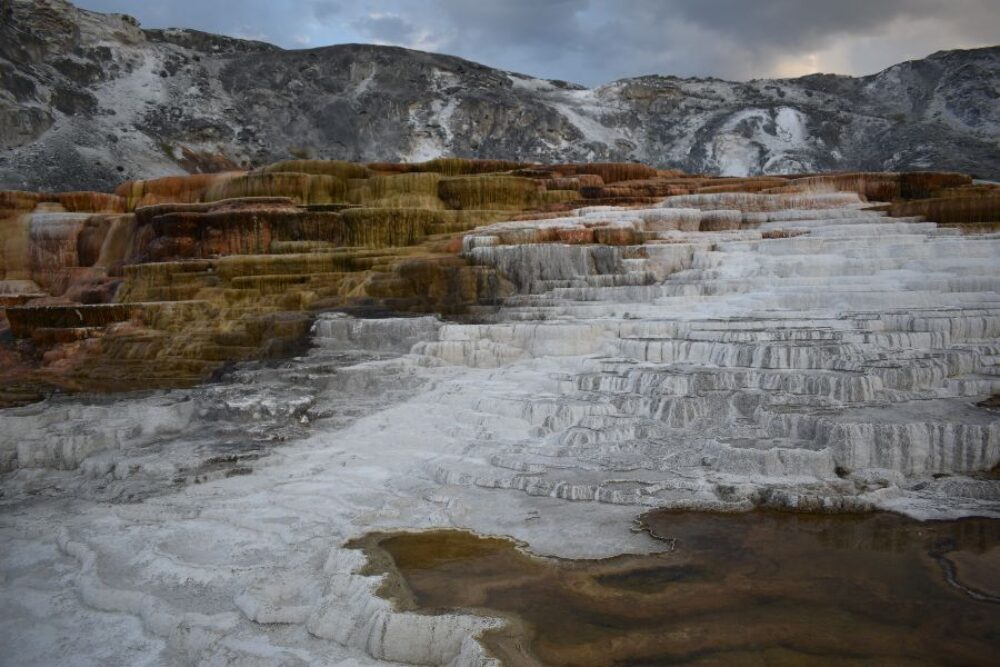
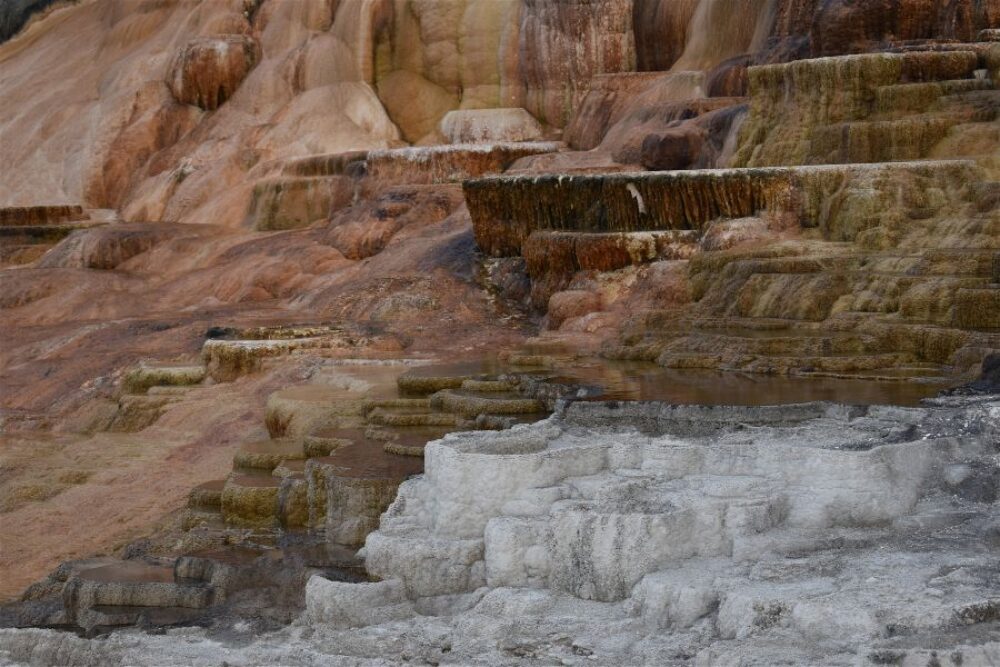
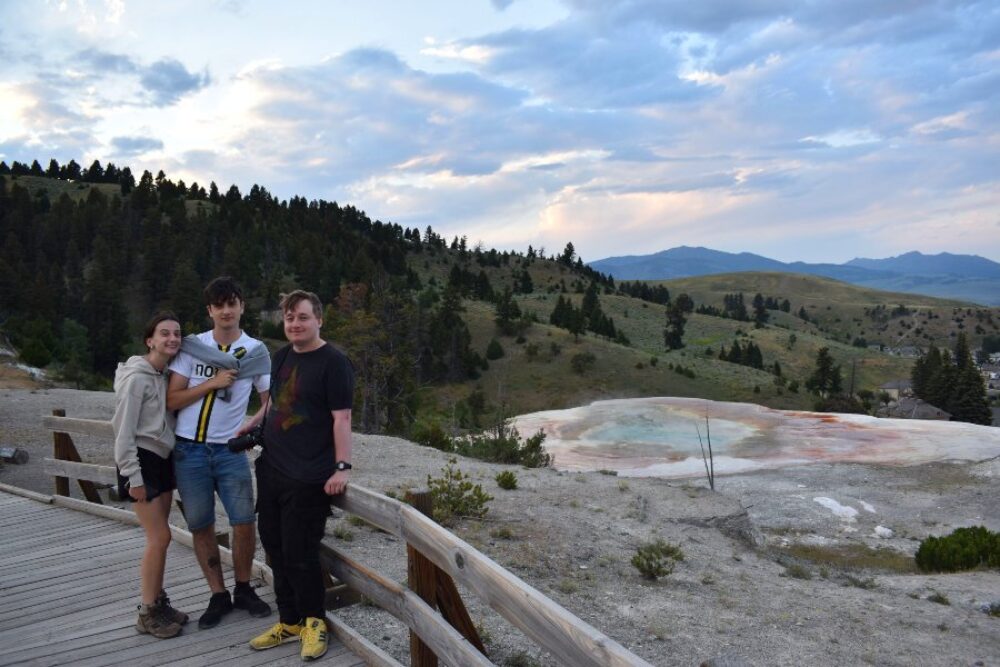
- Mammoth Hot Springs (1 on the map) - further afield but well worth a visit. Two terraced boardwalks guide you through an area that looks like a cave turned inside out. Approximately 50 hot springs lie within the area, along with a visitors' centre (by the way, if you click on any photograph on this website it expands and provides detail about the image)
- Norris Geyser Basin (2) - Yellowstone’s hottest geyser basin where a research drill hole measured a temperature of 459 degrees F (237 degrees C)
- Artists Paintpots (3) - a small hydrothermal area south of Norris Junction that includes colourful hot springs and two large mudpots that make a fab noise
- Lower Geyser Basin (4) is home to approximately 100 features that include all four main types of geothermals - fumaroles, hot springs, geysers and mud pots
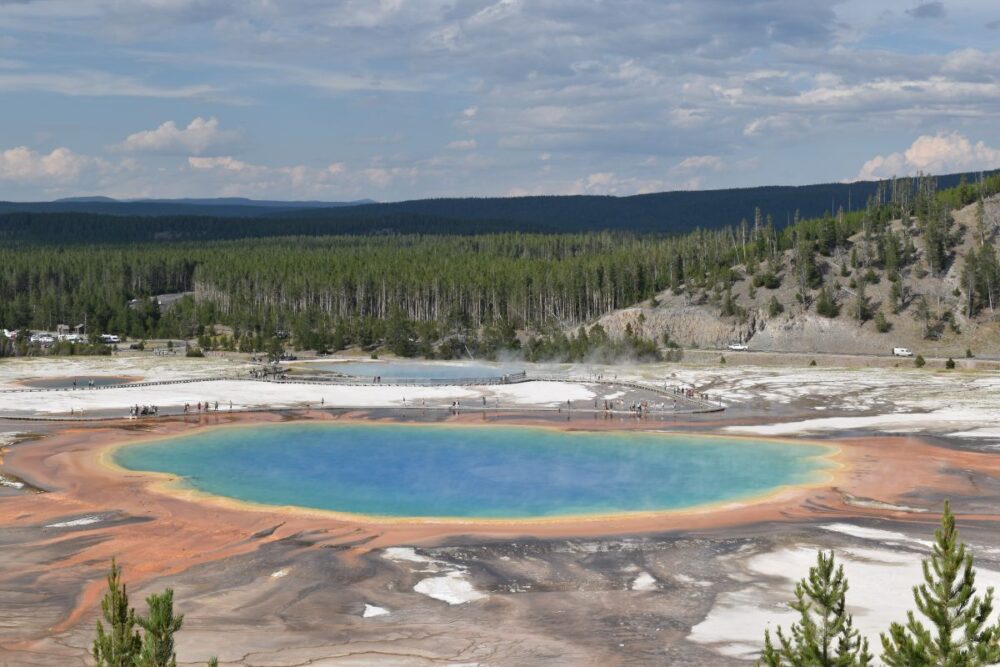
- Midway Geyser Basin (5) - including Grand Prismatic, the best known pool in Yellowstone with a deep blue centre and orange spider legs radiating out (blog cover image). Grand Prismatic is Yellowstone's largest single hot spring and the world's third largest. A 0.6 mile hike starting from the Fairy Falls Trailhead brings you to a fabulous view overlooking the Grand Prismatic Spring and the Midway Geyser Basin
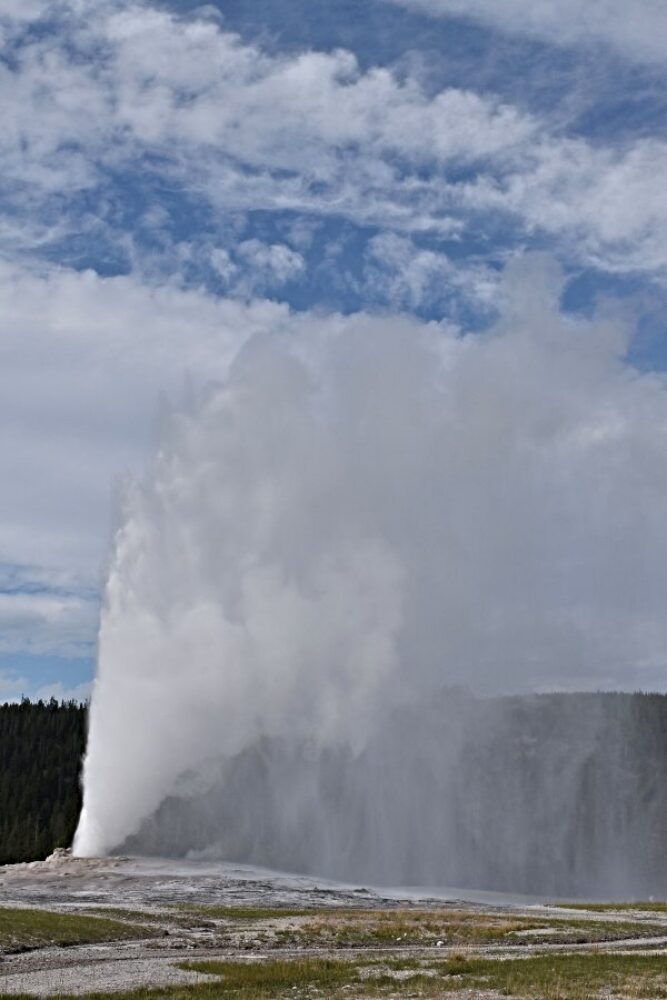
- The Upper Geyser Basin (6) - Yellowstone’s largest geyser basin with Old Faithful, Beehive, Castle and the Riverside geysers. At the end of a path by the Old Faithful Inn you will see the Morning Glory Pool. Morning Glory has lost some of its brilliant blue colour as a result of people throwing things in, which plugged up the pool leading to a cooling and subsequent reduction in the number of thermophiles - restoration work has been undertaken
- West Thumb Geyser Basin (7) - the most famous hydrothermal feature at West Thumb is a geyser on the lake shore known as Fishing Cone
- Mud Volcano (8) - located just north of Yellowstone Lake, the Mud Volcano area includes over a dozen unique geothermal features




The Grand Canyon of Yellowstone
The Grand Canyon of Yellowstone is the most breathtaking sight inside the Park. Twenty miles long, the canyon is up to 4,000-feet wide and 1,200-feet deep. From several vantage points along the North and South Rims you can view Lower Yellowstone Falls plunging 308 feet into the canyon, or Upper Yellowstone Falls tumbling 109 feet. It is fair to say that Lower Yellowstone Falls is the most impressive waterfall in the park.
The best way to visit the North Rim is to drive to each overlook. This saves lots of time and energy as several of the short hikes here are very steep. Lookout Point is the easiest place to get a breathtaking view of Lower Falls. Red Rock Point is a short, steep 30-45 minute hike providing you with arguably the best view of Lower Falls. If you want a different perspective then the Brink of the Lower Falls hike is a strenuous 30-60 minute walk that gets you up close to the top of the falls.
The most popular viewpoint of the canyon, Artists Point, is a very short walk from a car park on South Rim Drive. Artists Point gives a great view up the canyon to Lower Yellowstone Falls. You can also hike the South Rim Trail, a 1.75 mile trail (one-way) that connects Chittenden Bridge with Artists Point. For the best lighting you should visit Artists Point in a morning, and preferably early before it gets too busy.
The impressive colours of the canyon are caused by hot springs and steam vents in the canyon walls - for thousands of years upwardly percolating fluids have altered the chemistry of the rocks turning them yellow, red, white, and pink.
The canyon is also a great place for bird watching with up to 10 osprey nests being occupied through spring and summer in the area close to Canyon Village.


Yellowstone's ''Big 5'' | my first sighting of a grizzly bear and a wolf pack
Yellowstone is home to the largest concentration of mammals in the lower 48 states of the USA. Yellowstone’s wildlife is abundant and diverse with an estimated 300 species of birds, 16 types of fish, and 67 species of mammals. Yellowstone's official ''Big 5'' are the gray wolf, bear, bison, elk, and moose.
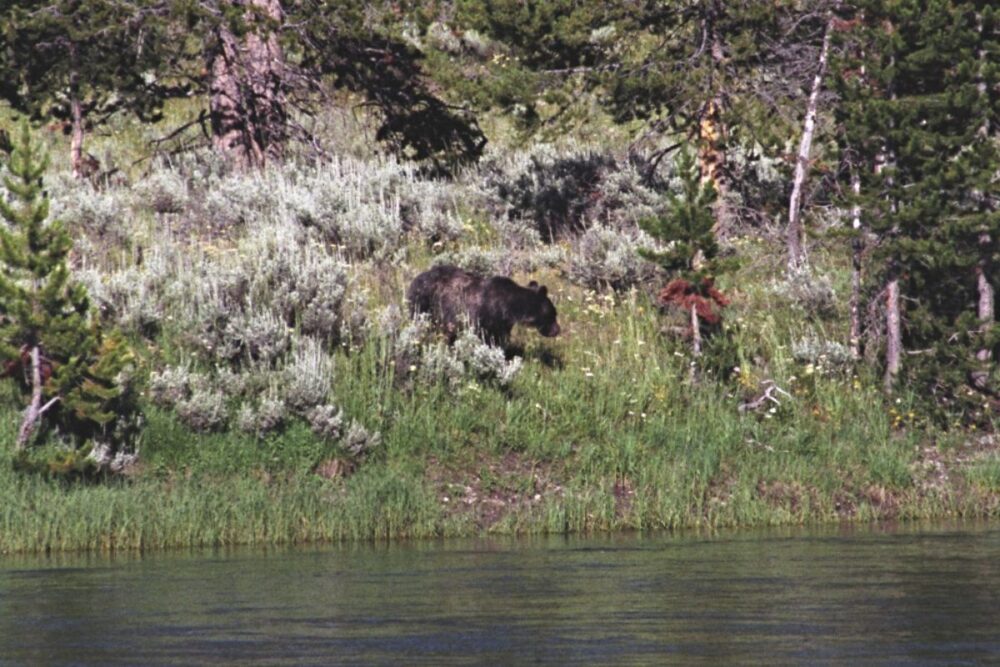
This trip was my second to Yellowstone, it was during my first trip that I fell in love in wildlife - while sitting on a riverbank eating a sandwich (with honey nowhere to be seen!), I noticed something in the distance on the other side of the river. As the object came closer I noted it was swaying slowly from side to side, and before long I realised I was looking at a grizzly bear. I felt great excitement. The great big grizzly waded into the river for a swim and wash, and then got back out (fortunately the same side it got in), stood up tall scratching its back on some bark, and then walked off into the distance.
On this occasion, one of the main ambitions of our trip was to see a wolf in the wild for the first time, and we did not leave disappointed as we witnessed a wolf pack coming out of their den one early misty morning. Seeing the whole pack, including the cubs rolling around with each other, was a sight to behold. Grey wolves were reintroduced to Yellowstone on the 12th January 1995, having been made extinct in the region nearly 100 years ago. The reintroduction has been a great success story, not only in how the wolves have thrived, but as a result of the wolves reducing the number of elk, which were overrunning Yellowstone, the numbers of other species such as beaver, lynx, and wolverine have rebounded.

Hiking, bison, and eternal memories
There are approximately 1,000 miles of hiking trails in Yellowstone. The best hikes include Avalanche Peak (4 miles), the Beaver Ponds Trail (5.4 miles), and Mount Washburn starting at the Dunraven Pass Trailhead (6 miles).
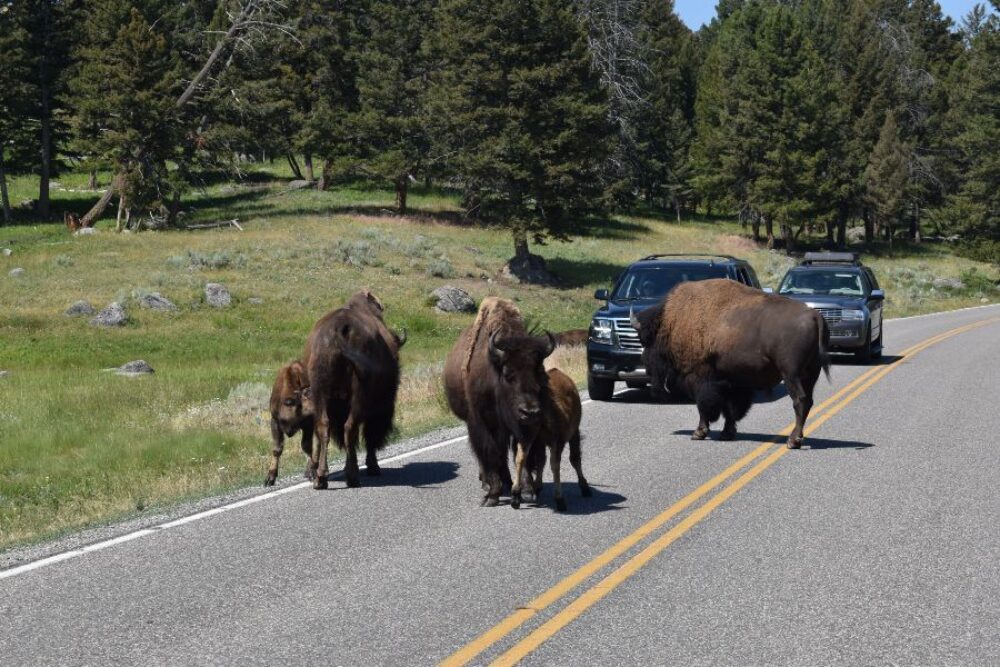
Talking of bison, these are yet another sight to behold in Yellowstone. Roaming free, these enormous animals are well known for causing traffic jams as they stroll casually down the middle of the road. Park rules (and common sense!) state that you must stay at least 25 yards from bison and 100 yards from bears and wolves - we witnessed someone getting a selfie with a bison, unfortunately the human was not devoured (this sentence does not involve a typo!).
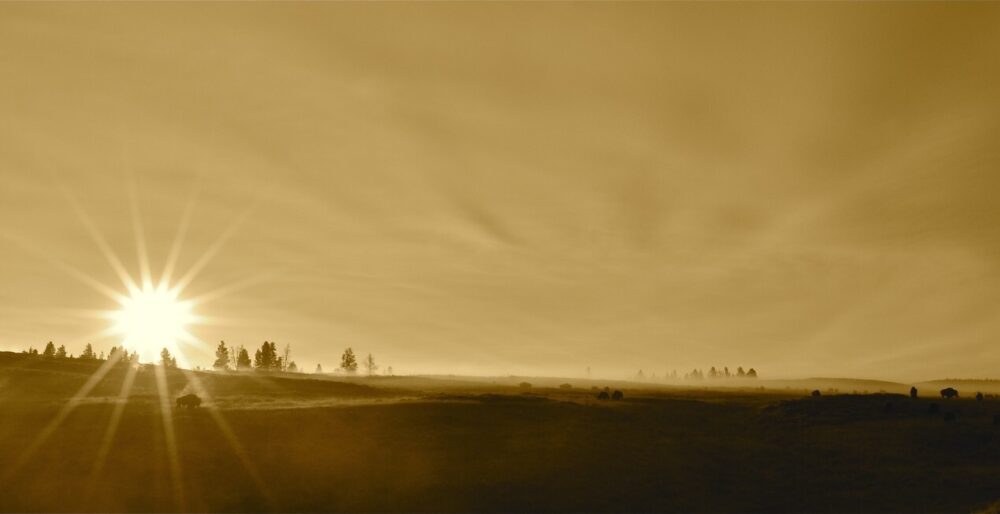
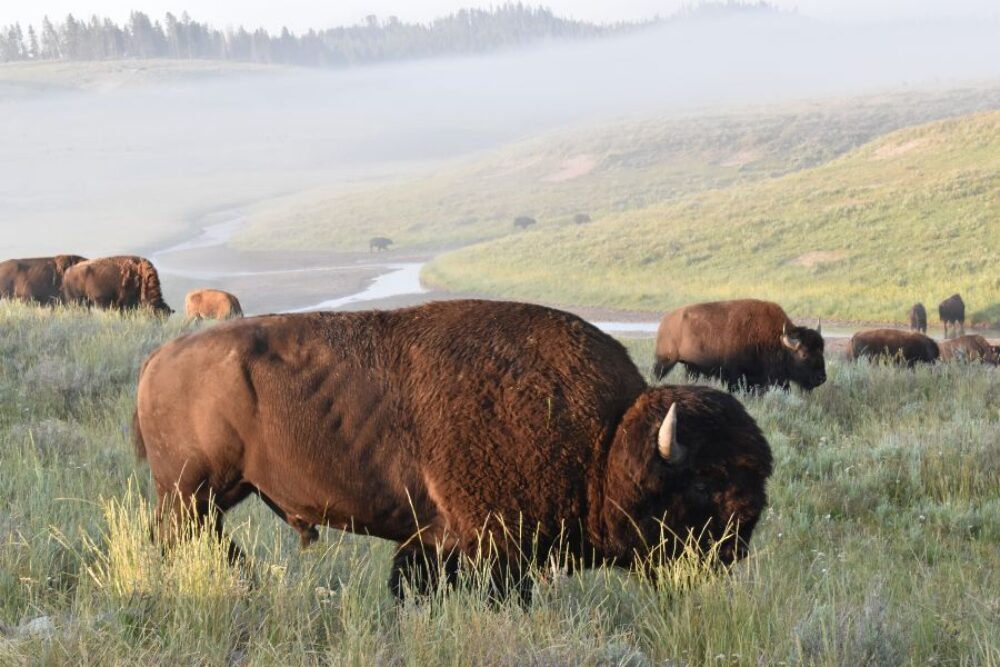
On this trip our first sightings of bison were of individuals, but on our final morning my daughter and I set off for a sunrise drive while the boys snored away in their sleeping bags. As we came through some low lying mist we were greeted by a massive herd of bison slowly making their way across the park, it was like a scene from Jurassic Park ... minus the dinosaurs.


Doing more to protect our planet
There were once 30 million bison in North America. A mass slaughter in the late 1800s nearly wiped out the entire population. Today, 5400 bison call Yellowstone their home and are one of the reasons why over 3 million people visit the park every year. Clearly, a significant portion of the world's population have an affinity for wildlife, so why is it we continue to allow the mass destruction of our natural world and the wildlife that lives within? Please visit my Leave for Others blogs and help make a difference.