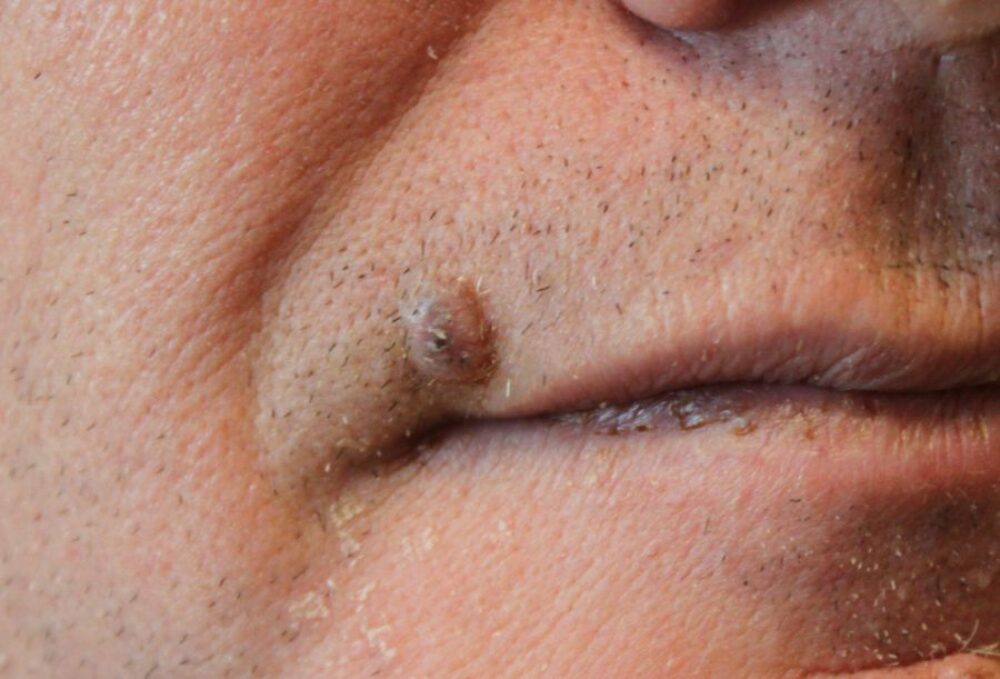
<p>A 47 year old man was referred with a five year history of a slow growing 'mole' above his upper lip. The lesion had not bled and was asymptomatic. What is the differential diagnosis?</p>

<p>Clinically the differential was between a BCC and a melanocytic naevus. Dermoscopically there were several branching (arborising) vessels, and also blue clods (blue arrow) in keeping with a BCC.</p>

<p>What else can you see? In the image below the arrow denotes a subtle change in the skin.</p>


<p>Dermoscopically the lesion can be seen circled in black. The texture is somewhat 'gelatinous', there are some fine branching vessels and a few white lines, all in keeping with a BCC. </p>
<p>With the aid of dermoscopy we have been able to detect a BCC at 2.5 mm in diameter, at this stage the lesion can be removed with a small circular excision leaving a very small scar, keeping morbidity to a minimum.</p>
<p>When you find one BCC make sure that you examine the head and neck closely, as well as the rest of the body as it is not uncommon to find another BCC, and occasionally more serious types of skin cancer. </p>
<p>Images property of South Tees NHS Foundation Trust.<br></p>