<h1>The Italian Dolomites<strong><em></em></strong></h1>
<h5>The Dolomites is a mountain range like no other, and as such is recognised as a UNESCO World Heritage Site. Situated in the northern Italian Alps, it has 18 peaks above 3,000 metres. The Dolomites feature some of the most beautiful mountain landscapes anywhere in the world, with sheer cliffs, and a high density of narrow, deep, and long valleys - it is undoubtedly the most dramatic scenery that I have seen. One of the many reasons to visit the Dolomites is that it is extremely easy to combine the mountains with some of Italy's most iconic cities. Our holiday was something of a horseshoe - flying to Pisa to visit the Leaning Tower before moving on to Florence, then 4 days later driving five hours north to the Dolomites. At the end of the holiday we drove three hours south to Venice. </h5>

<h3><strong>The geography of the Dolomites</strong></h3>
<p>The Dolomites (Italian: Dolomiti) are in the <strong>north-east of Italy</strong>, between the Austrian border in the north and the big Venetian plain on the south. These mountains cover an area of more than 90 km north to south and 100 km east to west. </p>
<p>The fantastic scenery of the Dolomites, there shapes unlike many other mountains on Earth, is due to their geology. The main geological difference is the combination of <strong>two distinct kinds of rock, volcanic and dolomitic</strong>. Not all the rocks are made of dolomite - the Marmolada (the highest peak of the Dolomites – 3343 m) is composed of limestone.</p>
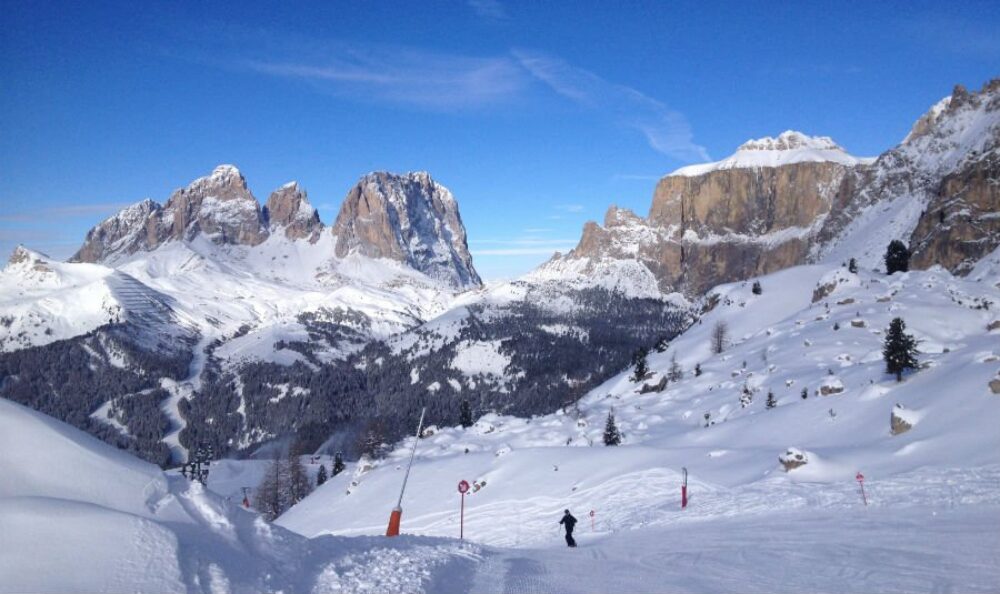
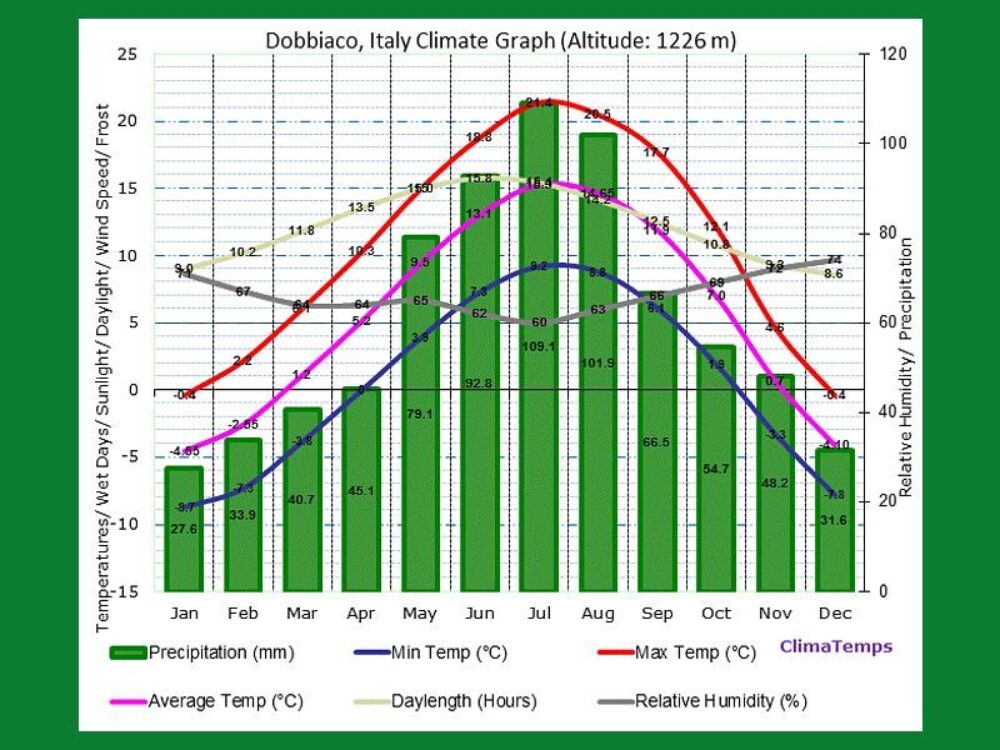
<p>From <strong>mid-June to the end of August, the climate is pleasantly warm during the day</strong> and fresh during the night, although from mid-July onwards, afternoon thunderstorms are not uncommon. In <strong>September/October</strong> the weather is often stable and clear, with the possibility of snowfall on the highest peaks - during these months there are fantastic autumn colours in the forests. <strong>Snow </strong><strong>usually begins to accumulate in December</strong>, lasting sometimes into April, and although snowfall is ample, the sun shines an unparalleled 8 days out of 10 in the Dolomite’s – more than any other range in the Alps! </p>

<h3><strong>Madonna di Campiglio</strong></h3>
<p>Our first port of call in the mountains was <strong>Madonna di Campiglio, </strong>which as with most parts of the Dolomites was a lovely village set amidst beautiful scenery. One could have spent days here exploring the outdoors but instead we had a quick stop over before setting off the following morning to the <a href="http://www.raftingcenter.it/en/" style="background-color: initial;"><strong>Rafting Center Val di Sole</strong></a><strong></strong>. The 'center' offers a wide range of sporting activities, but our only mission was to <strong>raft the Noce river</strong> - the river, which has its source at 3360 metre above sea level in the Ortles-Cevedale range, has 28 navigable kms of water and is recognised by the <strong>National Geographic as one of the top ten whitewater experiences in the world</strong>. Indeed we were not disappointed, after a morning of what we thought were rather good rapids our guide informed us that the real whitewater was still to come :-) and he was not wrong. Activities such as rafting should be booked well before your date of travel so as not to miss out. <br></p>

<h3><strong>Alpe di Siusi</strong></h3>
<p>After finishing rafting we headed east to what would be our base from which to explore the Dolomites, an area known as the<strong><strong></strong></strong><strong> </strong><strong>A</strong><strong>lpe di Siusi</strong> where we made quite an entrance to our hotel the <strong><a href="http://www.alpinadolomites.it/en/">Alpina Dolomites</a>.</strong> Now of course we usually self-cater on our holidays, but we thought we would treat ourselves for the week and not cook, but as we passed the spa and proceeded to the hotel, we started to become somewhat amused by all the Lamborghini’s and so forth parked outside .... it is fair to say that the valet parking staff were a little taken aback as we all fell out of our nine seater white van, with its wing mirror hanging off, still wearing our now dry clothing that we used for the rafting :-) The reception staff were equally perplexed when I asked for some Duct tape so that I could try and fix the broken mirror. To the hotel's credit they provided me with the tape, and yes, the hotel was lovely.</p>
<h3><strong>A high-altitude plateau</strong></h3>
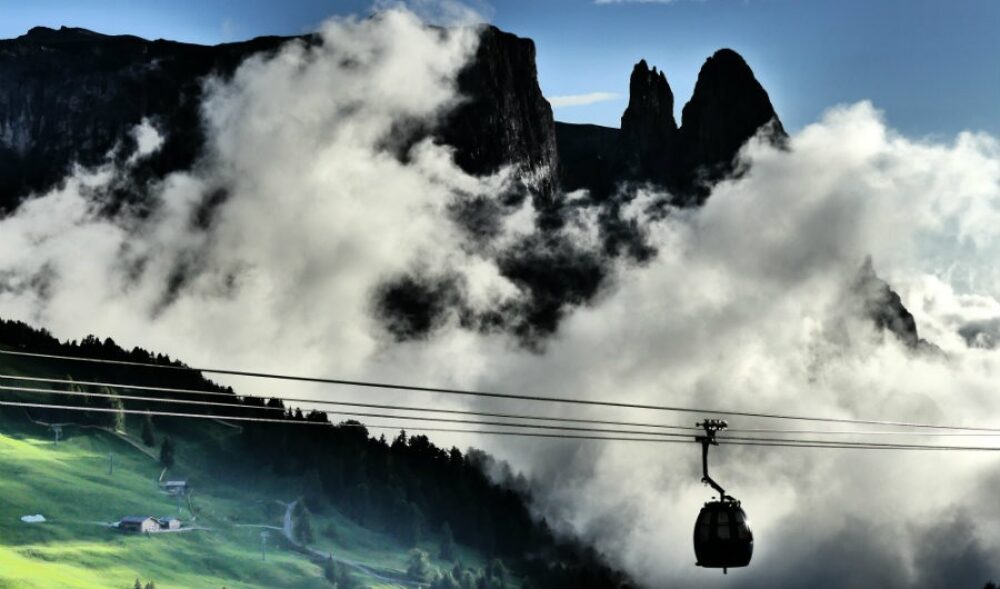
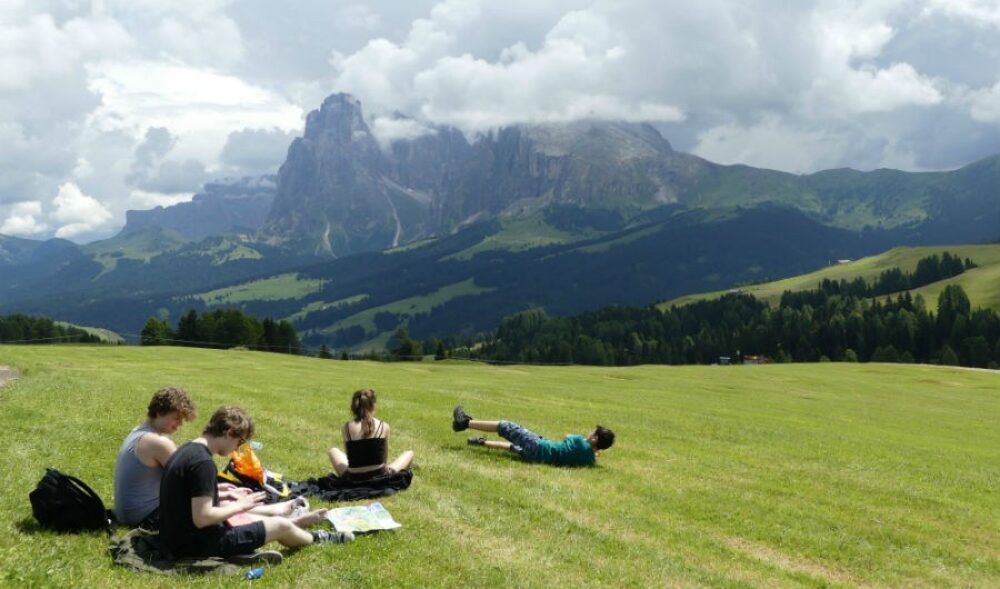
<p><strong>Alpe di Siusi</strong> is Europe’s most beautiful and largest high-altitude plateau. We did not plan any specific hikes in the immediate area, instead we simply headed out from the hotel and walked on whichever trail took our fancy, and there were many. Of course if you want a rest now and again then you can hop on one of the many chairlifts that serve the region summer and winter, in addition to the shuttle bus service ... of course these forms of transport don't come free, but are very <strong><a href="http://www.seiseralm.it/en/info/getting-around/alpe-di-siusi-cable-car-summer">affordable</a></strong><a href="www.seiseralm.it/en/info/getting-around/alpe-di-siusi-cable-car-summer.html">.</a> In addition to hiking, the plateau is a great place for family mountain biking and also parapenting. While the Dolomites often have pleasant summer weather, like all mountainous areas the weather can change quickly so be prepared. We witnessed some terrific thunderstorms, fortunately most of which were from the hotel, and at a height of 1800 metres you felt like you were in the middle of the storm with the thunder bouncing from one mountain to another. If you wish to plan your itinerary a little more than I did then visit the <strong><a href="http://www.seiser-alm.it/en/">local website</a>.</strong></p>
<h3><strong>Exploring the Dolomites</strong></h3>
<p>In terms of exploring the wider area we managed to achieve all that we set out to do which was:</p>
<ul><li>To drive the <strong>Great Dolomite Road</strong></li><li>To visit the <strong>Funes Valley</strong> and walk the <strong>Adolf Munkel Trail</strong></li><li>To hike in the <strong>V</strong><strong>al Ciamin Valley</strong></li><li>To visit <strong>Lake Carezza </strong></li><li>And ... not to get lost too often </li></ul>
<p>Of course to get to such places you need a car, and <strong>always plan for a longer drive than the map suggests .</strong>.. although it may not look far on the map many of the smaller roads are very winding and can be slow going. </p>

<h3><strong>The Great Dolomite Road</strong></h3>
<p>The <strong>Great Dolomite Road</strong><strong>, </strong>open year-round, is a breath-taking scenic drive that crosses three alpine passes (Falzarego, Pordoi and Karerpass, at the renowned Rosengarten), connecting the Bozen and Bolzano regions. We took the whole day to drive the road, which afforded us great opportunities to get out of the car and do some short walks, to simply take in the stunning views and also to go up the <strong>Pordoi Pass Cable Car ... </strong>a four minute ride takes you to the Sass Pordoi, which at 2,950 metres is an amazing plateau overlooking the Dolomite landscape, the tightrope walk is not mandatory! On a sunny day you can comfortably sit back and enjoy a panoramic view over all the major peaks in the Dolomites, but on a day like ours with a mixture of sun and cloud it can be a little on the cool side so take appropriate clothing. </p>

<h3><strong>Hiking in the Dolomites</strong></h3>
<p>Our next day trip was to the <strong>'Val di Funes' </strong>or Funes Valley, this is where you will see the famous landscape of <strong>St. Magdalena village and church with a backdrop of the Odle Mountains</strong> (image at top of the page) - this image you may have seen before while browsing, indeed it may be the thing that inspired you to come to the Dolomites in the first place. To reach here is a 45 minute drive off the autobahn - you will need to follow signs for the village of Villnöß, or Funes in Italian (whichever your map says), or you may wish to rely on google maps. </p>
<p>Haven taken time to admire the views of the village and mountain backdrop we then pressed on to the <strong>Adolf Munkel Trail</strong>,<strong> </strong>which running below the imposing north faces of the Odle/Geisler Mountains, is one of the most spectacular trails in the Dolomites. The trail, which is 9 km long, begins in the parking area in <a href="http://www.valleisarco.info/en/holiday-areas/val-di-funes-valley/val-di-funes-villnoess/adolf-munkel-trail/"><strong>Zannes/Zans</strong></a>, and takes about 3 hours to complete with no difficult sections. </p>

<h3><strong>The Val Ciamin Valley Trail</strong></h3>
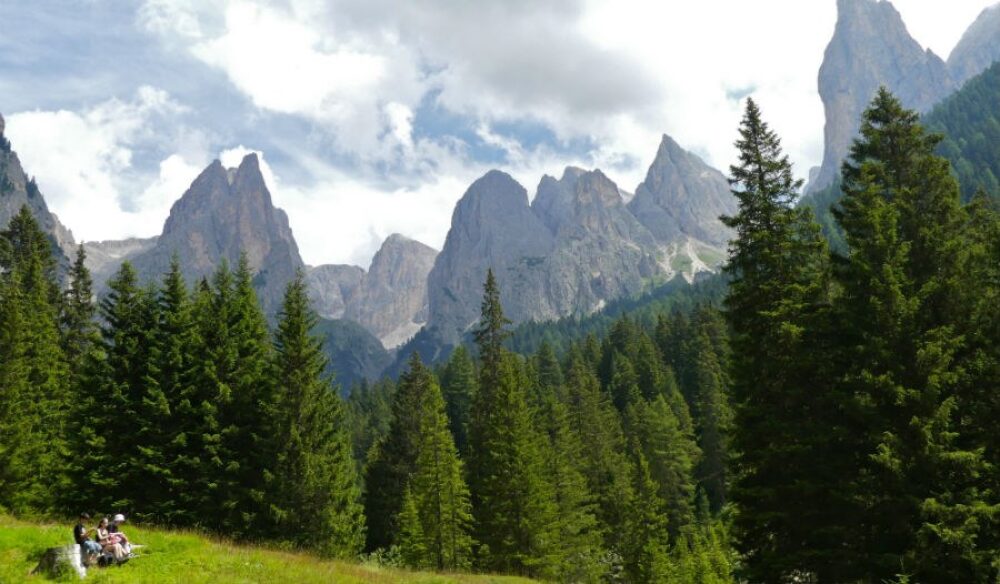
<p>My favourite hike turned out to be the last on our trip, and this was the <strong>Val Ciamin Valley Trail</strong> situated in the locality of Bagni di Lavina Bianca. Once again this was a moderate drive, so we set off in suitable time after our filling breakfast at the Alpina Dolomites Hotel. The walk into the valley begins at the visitor's centre of the Sciliar-Catinaccio Nature Park - the best way of finding this area is to put the name 'Lavina Bianca' in to google maps, when you zoom in the visitors centre will appear. The <a href="http://www.outdooractive.com/en/hiking-trail/dolomites-seiser-alm/hike-to-the-rechter-leger-in-the-val-ciamin-tschamintal-valley/16570254/"><strong>walk</strong></a><strong></strong>, which is largely one way, is 9 km long and takes approximately 3 hours, although once you reach your destination of the Rechter Leger, a pasture land with incredible views over the peaks of the Cime del Principe/Grasleitenspitzen and the Cima di Valbona/Valbonkogel, you will be more than likely bowled over, and afford yourself a long lunch break.</p>
<h3><strong>Lake Carezza</strong></h3>
<p>As well as avoiding thunderstorms, another good reason for starting your day early in the Val Ciamin Valley area, is the opportunity to visit <strong><a href="http://www.eggental.com/en/discover-eggental/nature-mountains/lake-carezza/">Lake Carezza</a></strong>, only a short distance away. This small mountain lake is well-known for its soft, deep green waters and the exquisite view of the Rosengarten and Latemar mountain ranges. The lake is at its most beautiful in the evening or early morning, when the Rosengarten-Latemar mountain ranges and the green of the Karerwald forest are reflected in its crystal clear water. This is a natural spectacle you won't want to miss. </p>

<h3><strong>Planning our next trip</strong></h3>
<p>Of course there is so much more to see and do in the Dolomites in the summer such as to hike around <strong>Tre Cime di Lavaredo</strong>, one of the most famous peaks in the Dolomites, visit <strong>Braies Lake</strong>, go up the cable car on the Marmolada, which at 3342 metres is known as the 'Queen of the Dolomites', or spend a day on the <strong>Via ferrate</strong> - these are protected mountain climbing routes consisting of anchored cables, rungs, steps, bridges, and ladders, which allows lesser or even inexperienced climbers to face otherwise dangerous but incredibly scenic routes ... all the more reasons to go back time and time again. For more information on the Dolomites please refer to the <a href="http://www.visitdolomites.com/en/"><strong>Visit Dolomites</strong></a> website and <strong><a href="http://www.suedtirol.info/en/regions/dolomites">other relevant sites</a>. </strong></p>

<h3><strong>Skiing in the Dolomites</strong></h3>
<p>The one time I have skied in the Dolomites I stayed in the lovely village of Arabba, which is not only relatively high when compared to other villages in the Dolomites, but also well-placed. For more information including ski videos of the area please refer to the <strong>ski blogs.</strong><br></p>