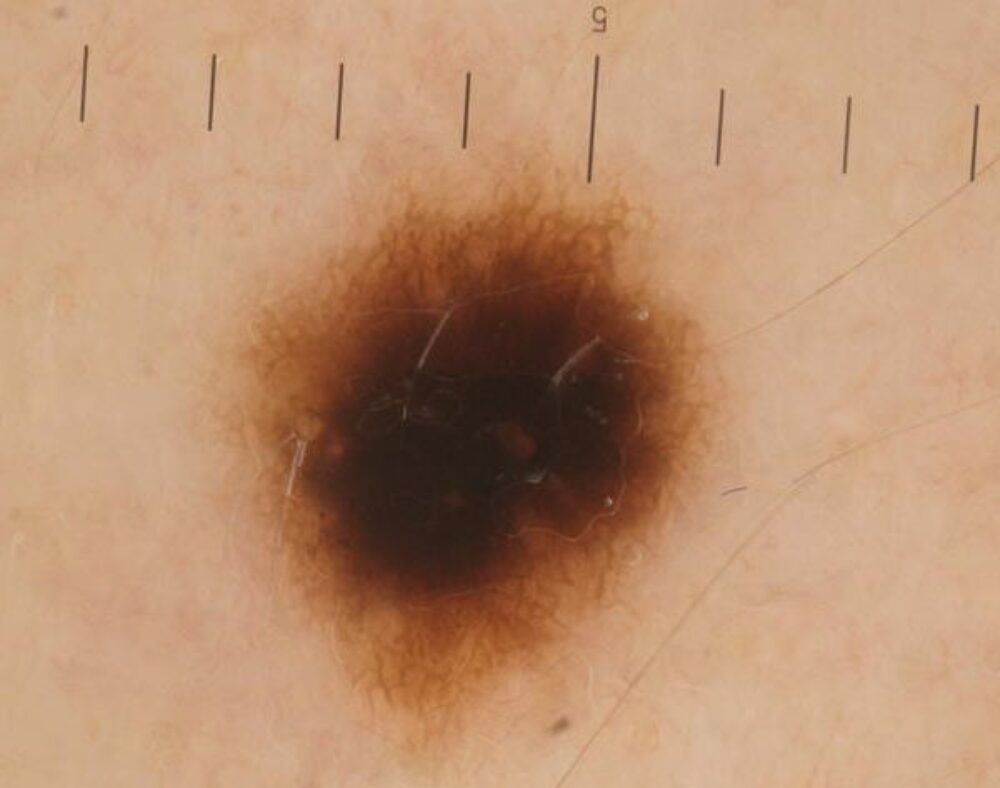
<p>A 35 year old man had been referred with multiple pigmented lesions, many of which looked mildly atypical. Dermoscopic images were taken of numerous naevi, including this one on his upper back (image top left), and a three month follow-up was put in place.</p>
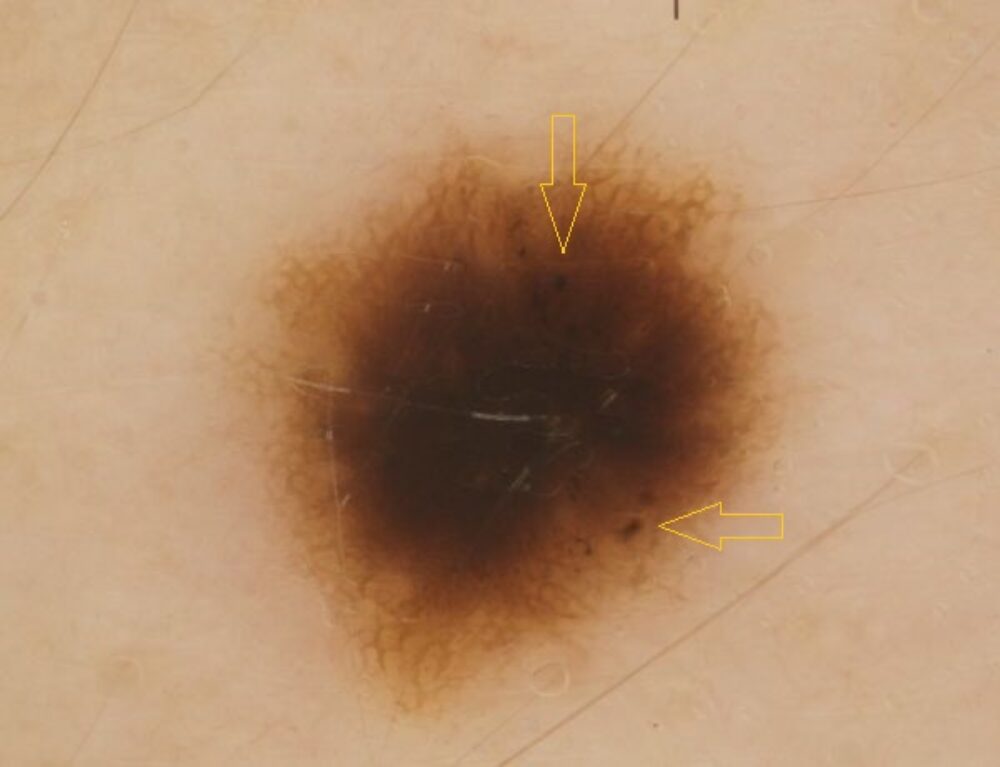
<p>Three months later the patient was reviewed. If you look closely at the follow-up image (top right) it can be seen that the dark structureless area had increased in size, and a few small black clods (yellow arrows) had become apparent. The finding of asymmetry plus an eccentric structureless area is a red flag, and so the lesion was excised. Histology revealed a severely dysplastic naevus, as such a re-excision was needed to take up to 5 mm of normal surrounding skin.</p>
<p><strong>An eccentric structureless area</strong> refers to a significant part of a lesion that contains no structures (eg no network, dots or clods), and can be black, blue, pink, white or occasionally brown. One would also expect there to be some asymmetry. It is not uncommon for some benign naevi to be a little darker centrally (but with the network still visible), or to have some small structureless areas that are skin-coloured to light brown - such features are not eccentric. To learn more about this topic please refer to the dermoscopy introduction document, which can be found on most of the dermoscopy blogs. </p>
<p>Another important thing to note is that <strong>dermoscopy follow-up requires careful image comparison</strong>, and this can only be achieved by comparing current and previous images digitally, side-by-side, on a computer.</p>
<p>Images property of South Tees NHS Foundation Trust.<br></p>
<p><strong>On a completely different note Happy New Year, and look out for the new travel blog on Croatia that is being posted this week.</strong></p>