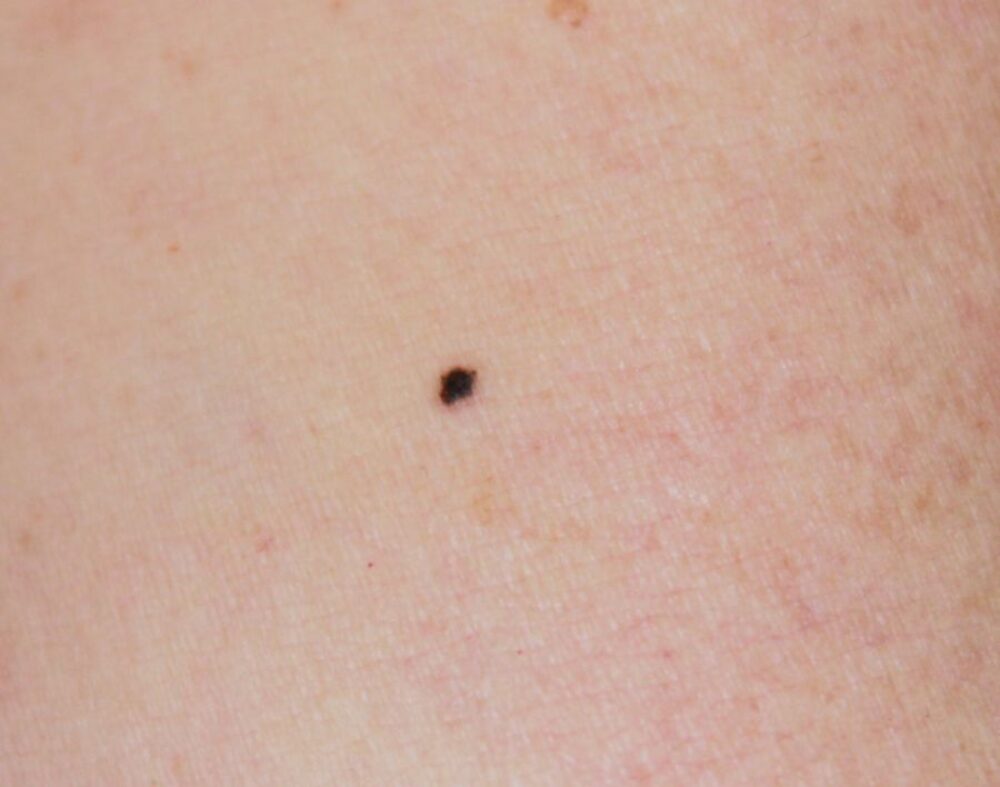
<p>This 27 year old was referred with a new lesion on the left inner arm. What is the differential and how would you manage this patient?</p>

Dermoscopy - Introduction, Terminology and Structures
A document to help you understand the dermoscopic descriptions used in this blog.
Dermoscopy Algorithm
To help you work through dermoscopic cases.
<p>Dermoscopically we see <strong>peripheral lines </strong>(arrows), also known as peripheral streaks. Peripheral lines are diagnosed as lines at the periphery that do not form an obvious part of the network (refer to adjacent introductory document).</p>
<p>Peripheral lines are only found in <strong>melanocytic lesions, in particular melanoma or a pigmented spindle cell naevus of Reed (PSCNOR)</strong>, which many believe is a type of <strong>spitz naevus. </strong></p>
<p>In a <strong>PSCNOR the peripheral lines tend to be relatively symmetrical</strong> giving a <strong>'starburst' </strong>appearance, compared to a melanoma where there is more asymmetry. In this case the lesion demonstrated significant asymmetry so the lesion was excised and sent for urgent histology, the results of which showed a <strong>PSCNOR.</strong></p>
<p><strong>PSCNOR</strong> tend to arise as small symmetrical black macules or papules in younger patients. Although they are benign they can be difficult to differentiate from melanoma and so should be <strong>referred as a 2-week wait</strong> to secondary care, as should any lesion with peripheral lines. However, if a PSCNOR is likely then at least the patient can be informed that they are being referred to be on the safe side.</p>
<p>From a <strong>secondary care perspective </strong>many such lesions are excised to confirm the diagnosis, however, in young patients with a highly symmetrical 'starburst' pattern the lesion may instead be closely observed and then left alone if the lesion keeps its symmetry and stops growing.</p>
<p>Follow this link for more information on <a href="http://www.pcds.org.uk/clinical-guidance/spitz-naevi-including-pigmented-spindle-cell-naevus-of-reed">spitz naevi</a>. </p>