<h1>Icefields Parkway | my top 10 things to see and do</h1>
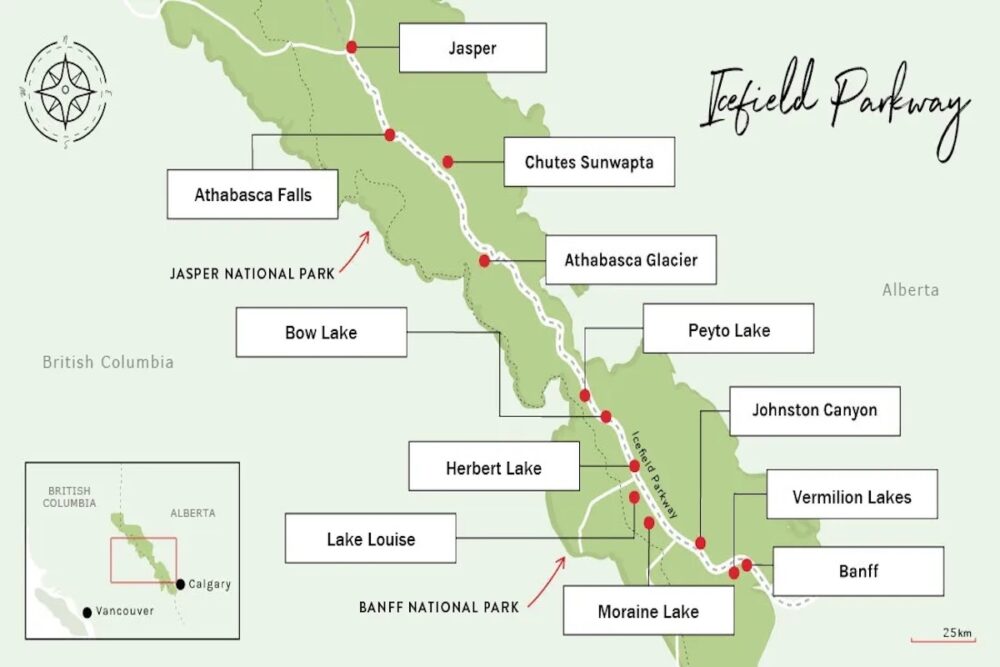
<h5>Welcome to my top 10 of the Icefields Parkway, a scenic 232 km (144 mile) highway in the Canadian Rockies that connects Lake Louise Village (Banff National Park) to Jasper Townsite (Jasper National Park). Also known as Highway 93, the Parkway is renowned as one of the world's most beautiful drives, offering views of mountain peaks, glaciers and turquoise lakes. The route is open year-round.</h5>
<h5>While it is possible to explore parts of the Parkway from either Banff National Park in the south or Jasper National Park in the north, to get the most out of this area it is best to put aside two full days, ideally using the accommodation between Lake Louise and Jasper. Other than campsites, accommodation along the Parkway is limited, varying from hostels to the luxury Glacier View Lodge.</h5>
<h3><strong>1. Take a dip in Herbert Lake, or just admire the view</strong></h3>
<p>Distance from Lake Louise Village: 5.7 km<br>Distance from Jasper Townsite: 226 km</p>
<p>The first stop you’ll come across when you cross the park gates is Herbert Lake on your left-hand side. The lake is literally right off the side of the road and has a big parking area. After you park it’s only a few steps until you are at the lake. Once here you can sit in silence and enjoy the views of Mount Temple or go swimming in the lake.</p>
<p>If you rather a hike, 15 km further north brings you to the trailhead of the 2.2 km hike to <strong>Hector Lake</strong>, be prepared though as the trail has a reputation for being muddy.</p>

<h3><strong>2. Bow Lake</strong></h3>
<p>Distance from Lake Louise Village: 37.1 km<br>Distance from Jasper Townsite: 194 km</p>
<ul></ul>
<p><strong>Bow Lake </strong>is another beautiful lake, which is a brilliant aquamarine colour on a sunny day. Bow Lake is one of the largest lakes in the park, is surrounded by large mountains, and affords great views of the <strong>B</strong><strong>ow Glacier.</strong></p>
<p>If time allows it is worth the 9 km hike (round trip) to <strong>Bow Glacier Falls</strong>, the hike has limited elevation gain and skirts the lake. At the time of writing the hike was closed as a result of rockfalls. <br></p>

<h3><strong>3. Peyto Lake, not to be missed</strong> </h3>
<p>Distance from Lake Louise Village: 43.9 km<br>Distance from Jasper Townsite: 188 km</p>
<p>Peyto Lake (pronounced PEE-toh) is another glacier-fed lake in Banff National Park. This is probably the third most popular lake to visit in Banff, after Lake Louise and Moraine Lake. With a unique shape and absolutely <strong>mind-blowingly blue water</strong>, the lake is visible from the scenic overlook, which is only a 10-minute walk from the parking lot and has disabled access. </p>
<p>During the summer, significant amounts of glacial rock flour flow into the lake from a nearby glacier, these suspended rock particles are what give the lake a bright turquoise colour. The Peyto Lake area is renowned for its <strong>wildflowers</strong>, which are at their best from late July to early August. <br></p>

<h3><strong>4. Saskatchewan River Crossing - more a point of interest</strong></h3>
<p>Distance from Lake Louise Village: 78.7 km<br>Distance from Jasper Townsite: 153 km</p>
<ul></ul>
<p>The Crossing, at which the <strong>Mistaya and Howse Rivers meet the North Saskatchewan River</strong>, has long been identified as a strategic location in the history of the Canadian West. In the early 1800’s the Fur Traders (boo....) crossed the North Saskatchewan River, then followed the Howse River to the Howse Pass, which breeched the Rocky Mountains into what is now the province of British Columbia. Howse Pass is lower than many other passes in the Rockies and was considered for the Canadian Pacific’s rail line; the Kicking Horse Pass was chosen instead.</p>
<p>It is remarkable to think that the waters seen here eventually find their way to <strong>Hudson Bay</strong>, first passing through Lake Winnipeg. </p>
<p>Back to the crossing, there is a convenience store/souvenir shop, a cafe, and a very overpriced gas (petrol) station.</p>

<h3><strong>5. Big Hill and Big Bend - another viewpoint </strong></h3>
<p>Distance from Lake Louise Village: 115 km<br>Distance from Jasper Townsite: 117 km</p>
<p>Big Hill and Big Bend are a <strong>popular viewpoint</strong>. This spot features a large hairpin turn and a steep climb that leads to a viewpoint offering panoramic views of the valley and river below. It's known as one of the most spectacular and scenic stops on the drive; however, unless you are here earlier or later in the day the view can be pretty hazy. </p>

<h3><strong>6. Parker Ridge - time to get out for a proper hike</strong></h3>
<p>Distance from Lake Louise Village: 119 km<br>Distance from Jasper: 112 km</p>
<p>This is <strong>one of the two best hikes along the parkway</strong>. The hike, at 6.4 km / 4 miles (round trip), is relatively easy taking <strong>2-3 hours</strong>.</p>
<p>Much of the hike is through meadows affording views of <strong>some of Alberta's highest peaks</strong> including Mt Athabasca (11,453 ft), Hilda Peak (10,039 ft), and on the other side of the valley, the shoulder of Mt Saskatchewan (10,965 ft).</p>
<p>At the top, the ridge provides amazing views of the <strong>Saskatchewan Glacier</strong>, the largest of the Columbia Icefield’s six valley outlet glaciers.</p>
<p>The 20-26 ft of snow that falls annually on Parker Ridge takes a long time to melt meaning this is <strong>one of the last trails to open in the Parkway</strong>; sometimes closed until early-mid July. In summer these meadows bloom with tall wildflowers, protected from the elements and fed by the abundant moisture from snowmelt. In fall, the meadows are a sea of gold and red, interspersed with islands of dense, stunted kruppelholz trees (another product of the short growing season in the alpine).<br></p>


<h3><strong>7. Time for another hike, Wilcox Pass</strong></h3>
<p>Distance from Lake Louise Village: 126 km<br>Distance from Jasper Townsite: 105 km<br></p>
<ul></ul>
<p>Wilcox Pass is <strong>regarded by many as the best hike on the Parkway</strong>, and we loved it. Wilcox Pass is a 9.3 km hike (round trip), and with 522 meters of vertical will take <strong>3-5 hours to complete</strong>. Wilcox Pass offers <strong>mesmerizing views of the glaciers</strong>. The hike flanks either side of Mount Athabasca and Andromeda, two of the tallest mountains in the Canadian Rockies; it is pretty much at the border between Banff National Park and Jasper National Park. The <strong>car park here is small </strong>and 'not suitable' for large campervans; we managed to squeeze ours in at a rather unorthodox angle. </p>

<h3><strong>8. Columbia Icefields - to visit or not?</strong></h3>
<p>Distance from Lake Louise Village: 130 km<br>Distance from Jasper Townsite: 105 km</p>
<p>In many ways the <strong>Icefield is remarkable</strong> - covering 325 square km (125 square miles), this is the <strong>largest icefield</strong> in North America's Rocky Mountains with ice that can be up to 365 meters (1,200 feet) thick. The glacier is fed by <strong>11 of the Rockies' highest peaks</strong> and is <strong>the source of rivers that flow into three different oceans</strong>.</p>
<p>The <strong>Columbia Icefield Discovery Centre</strong> is a visitor hub that serves as the gateway to the Athabasca Glacier (one of six of the icefield's outlet glaciers). The <strong>Athabasca Glacier experience</strong> involves taking massive vehicles with wheels taller than a person onto the Athabasca Glacier. We weren't convinced how much fun it would be to stand on a big block of ice, instead we crossed over the road and took the trail to the base of the glacier. As you walk towards the base there are markers denoting where the glacier used to reach, the speed of retreat is scary with as much as <strong>20 metres of horizontal ice lost each year, alongside as much as 6.5 metres of vertical ice</strong>. Well, at least our decision to not go on an energy hungry beast of a vehicle saved a little bit of ice!</p>
<p>Another trip from here is the <strong>Columbia Icefield Skywalk</strong>, which like many other skywalks is arguably overhyped - you can get just a good a view of this beautiful area by putting on your boots and going for a hike; the money saved and calories burnt means that you can enjoy the beautiful piece of Saskatoon Berry pie packed in your rucksack. <br></p>

<h3><strong>9. Sunwapta Falls - starting to near Jasper</strong></h3>
<p>Distance from Lake Louise Village: 177 km<br>Distance from Jasper Townsite: 55.4 km<br></p>
<ul></ul>
<p>Sunwapta falls is an easy stop, which is well worth venturing to. It consists of <strong>upper and lower falls</strong> fed by the Athabasca Glacier. The upper falls are more easily accessible and, therefore, much busier, but a 1.3 km hike will take you to the lower falls. Both are fantastic to visit in the <strong>summer and the winter</strong>.<br></p>


<h3><strong>10. Athabasca Falls - last but not least (or first if starting from Jasper)</strong></h3>
<p>Distance from Lake Louise Village: 201 km<br>Distance from Jasper Townsite: 32.1 km</p>
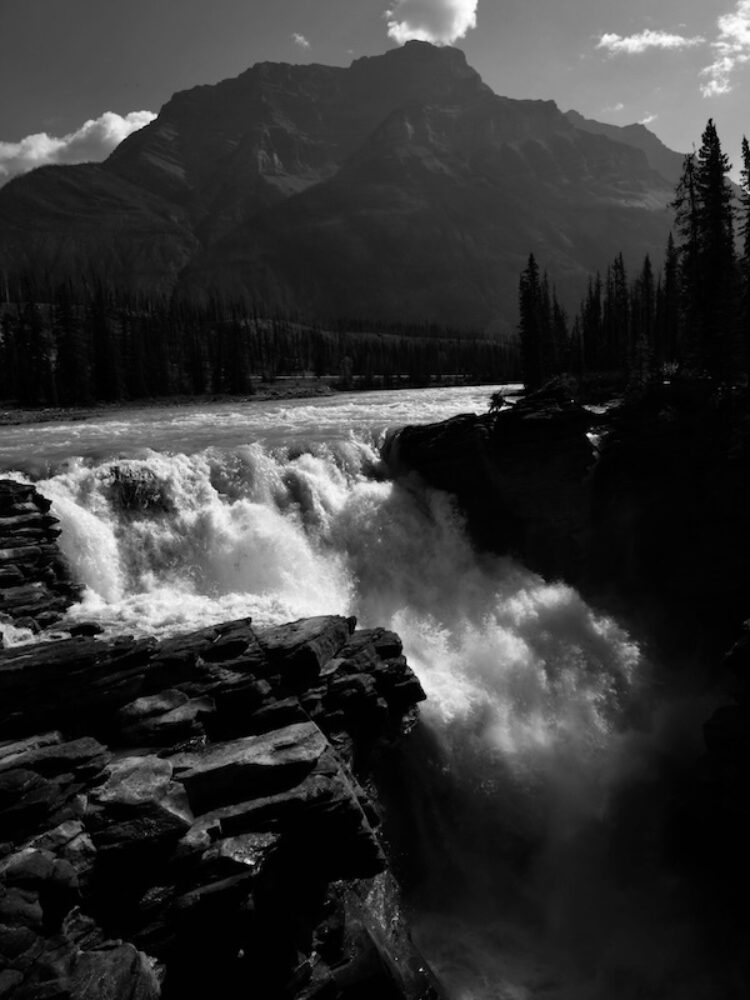
<p>Athabasca Falls, with a drop of only about 75 feet, isn’t a giant by waterfall standards, but that doesn’t mean it isn’t dramatic and majestic in its own right. The volume of water that rushes over the edge is impressive, making the upper Athabasca River roar – especially during the <strong>height of the thaw in late spring</strong>. There are ample short hiking trails to get you to viewing areas. Don’t try to get closer to take a good picture as the ground and rocks are treacherous and slippery; a fall into the frigid water and rocky canyon doesn't usually end well.</p>