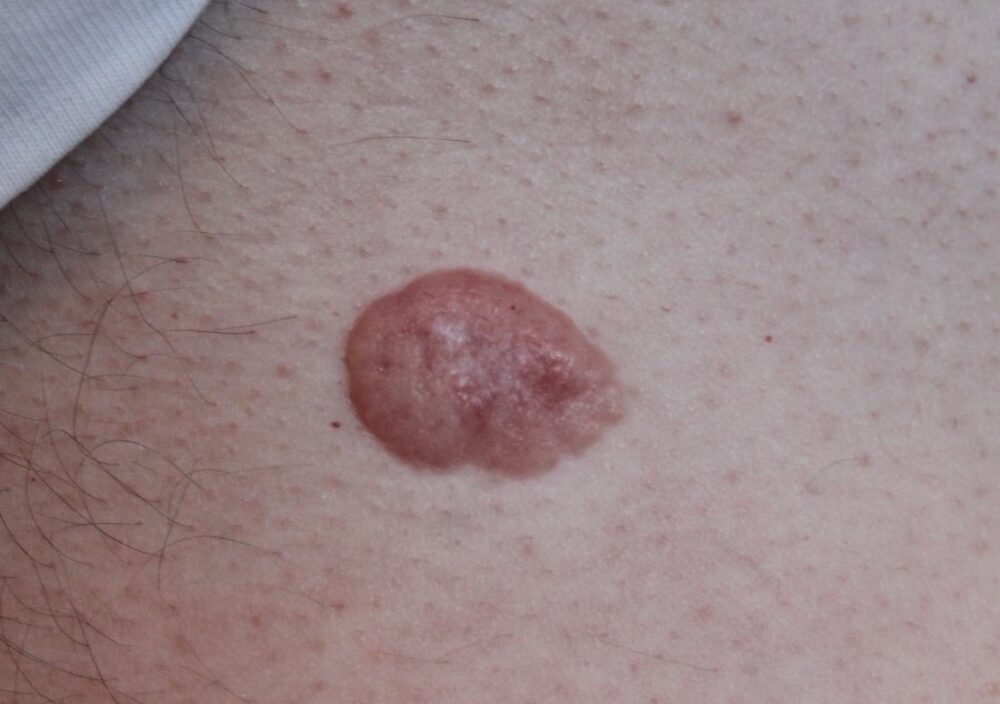
A 63 year old had become increasingly aware of a slow growing lesion on his back. What do you see dermoscopically and what is the differential?
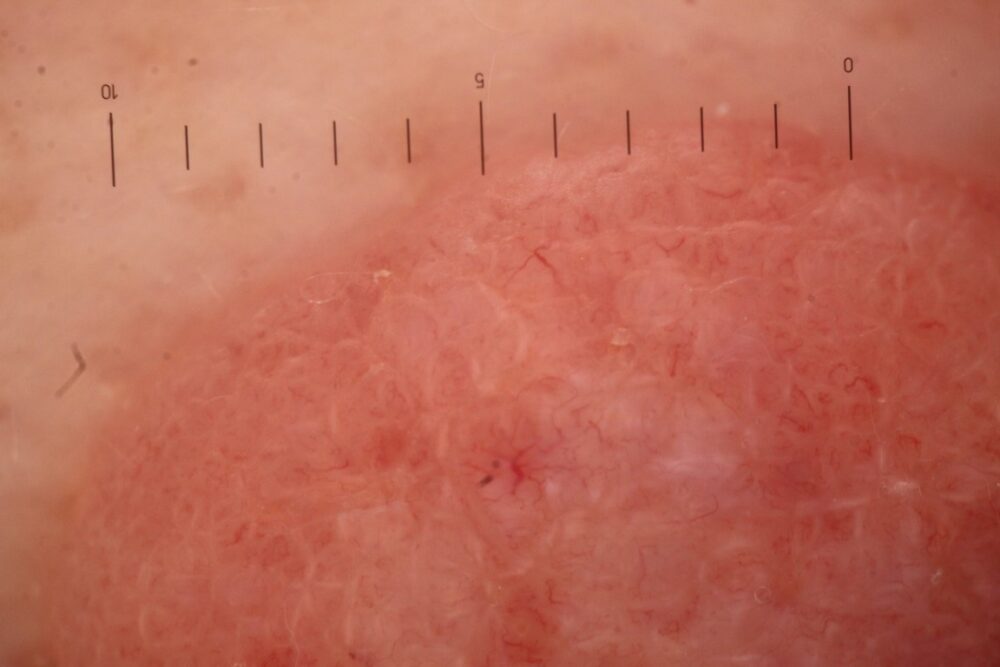

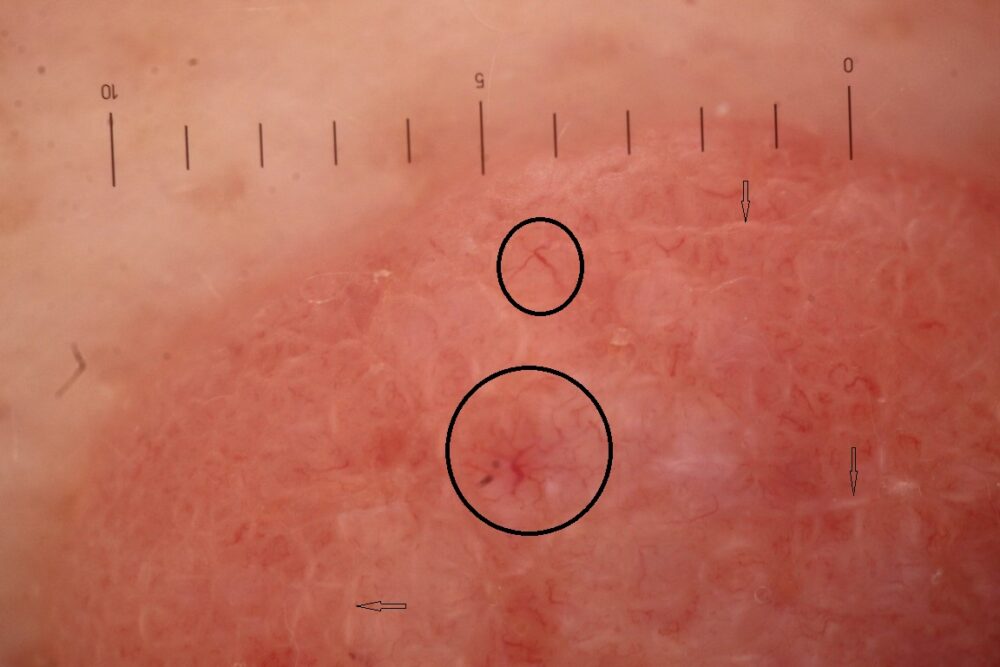
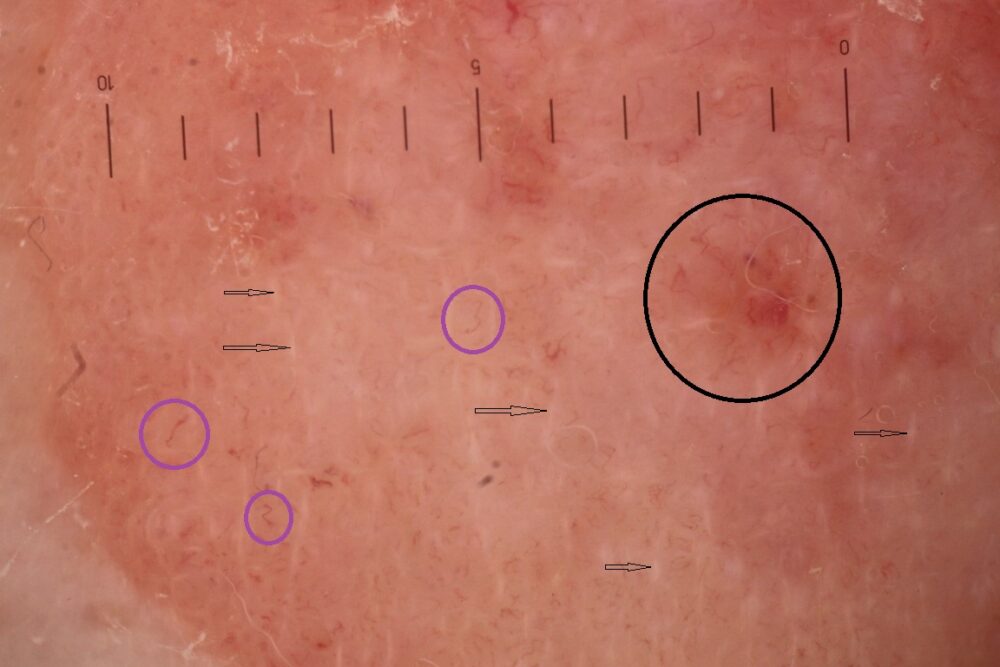
Demoscopically the vessels are mostly thin and well-defined. There are regions of small arborising vessels (black circles) as well as short irregular vessels (purple circles). There are many short white lines (black arrows). Given the history and clinicodermoscopic appearance the primary differential was a Fibroepithelioma of Pinkus +/- a BCC. Of course a hypomelanotic melanoma could not be excluded.
Histology revealed a Fibroepithelioma of Pinkus (FeP) in association with a BCC.
A FeP, first described in 1953 by Hermann Pinkus as a premalignant fibroepithelial tumour, is considered an uncommon variant of basal cell carcinoma. It manifests clinically as a solitary, pink to flesh-coloured (occasionally slightly brown-grey), well-demarcated plaque. Infrequently, FeP may be pedunculated, polypoid, or ulcerated. It is typically found on the trunk of persons aged 40 to 60 years and is thought to have an equal sex distribution. Although it shows a certain predilection for the lumbosacral area, it is not limited to this region and may develop on other body sites, including the extremities, abdomen, head, and genitalia.
Histology can reveal a pure FeP, although it is often found with additional features of a BCC or sometimes a seborrhoeic keratosis.
One paper examining the dermoscopic features of 10 such lesions found fine arborising vessels, either alone or associated with dotted vessels, and short white lines (in 100%, 70%, and 90% of lesions, respectively). Other reports have also remarked on small irregularly shaped and distributed linear vessels.
For those familiar with this website, short white lines are not very specific, and can be found in a number of benign and malignant lesions. In addition, the presence of polymorphous vessels (ie vessels that vary in appearance) can also be found in melanoma, as such a hypomelanotic melanoma should be in the differential, although the presence of arborising vessels along the fact that a large proportion of the vessels are of a similar calibre would go against melanoma.
Images copied with kind permission from South Tees Hospitals NHS Foundation Trust.